Making yoghurt at home
It's all Greek to me
- January 12, 2026
I enjoy making fermented foods, but I hadn’t dabbled in fermenting dairy until now. I was looking for a labneh recipe when I found this post1 by Marilena Leavitt from The Mediterranean Dish on how to make Greek yoghurt at home. This piqued my curiosity, so I went and bought the ingredients (yoghurt and milk) to make my own low-fat, lactose-free Greek yoghurt. After reading more about yoghurt-making in Sandor Ellix Katz’s The Art of Fermentation2, I knew that I could experiment with different ratios, incubation methods and troubleshooting – things I had a lot of fun with when baking sourdough. So, this is my record of my first attempt at making Greek yoghurt at home.
Yoghurt is a form of fermented milk in which bacteria convert lactose into lactic acid. Since I wanted to make lactose-free yoghurt, I hoped the bacteria would be fine with glucose and galactose instead of their usual lactose fare. The strains usually found in yoghurt are Streptococcus thermophilus and Lactobacillus bulgaricus, with Lactobacillus acidophilus and Streptococcus lactis sometimes added for their probiotic benefits3. The primary bacteria are thermophilic, meaning that they are activated at elevated temperatures2. This is one of the reasons that milk is usually heated before being inoculated with a yoghurt culture – warm milk activates the bacteria. Heating the milk also gives the final product a thicker consistency, as it changes the structure of the milk proteins and evaporates some of the water2. Greek yoghurt is simply plain yoghurt that has been strained to remove some of the liquid whey, rendering it thicker and more protein-dense than regular yoghurt1.
As with most ferments, making yoghurt requires a starter – in this case, more yoghurt. For my starter, I used plain, low-fat, lactose-free yoghurt that I bought at a store. When using store‑bought yoghurt as a starter, there is usually a limit to the number of successive backslopped batches you can make (backslopping is a term used to describe using an old batch as the starter for a new batch – in this case, using some of your homemade yoghurt to inoculate the milk for more homemade yoghurt2). Because of this limit on store-bought yoghurt, the best thing to use as a starter is heirloom yoghurt – yoghurt that has been perpetuated over generations. These heirloom cultures tend to be more microbially diverse than the one or two isolated bacterial strains found in store-bought yoghurt2. As I wasn’t able to get my hands on an heirloom culture, commercially produced yoghurt had to do (although the only live cultures in this yoghurt were Bifidobacterium, so I wasn’t certain how the fermentation would go), and I’ll see how many successive batches I can make from this.
Drawing on information from The Mediterranean Dish1, The New England Cheesemaking Supply Company3, 4, and The Art of Fermentation2, I decided on the following:
- Take the starter yoghurt out of the fridge and leave it to reach room temperature1.
- Heat the oven to its lowest temperature1. (I actually heated it to 130ºC to sterilise some jars, before realising that I could incubate the yoghurt in the pot I used to heat the milk. I let the oven cool down before the incubation step.)
- In an enamel Dutch oven1, slowly heat 2L of milk to 82ºC2, 4, stirring constantly2.
- Once the milk has reached the desired temperature, remove the pot from the heat and allow the milk to cool to between 43 and 46ºC3. (I let it cool to 45.8ºC.)
- When the milk has cooled to the desired temperature, stir 55g of the starter into one cup of the milk before returning that mixture to the pot and incorporating it into the rest of the milk. (The milk in the pot was at 45.2ºC when I stirred in the milk-and-yoghurt mixture.)
- Put the lid on the pot and place it in the still-a-bit-warm oven, switching the oven light on and letting the yoghurt incubate for six to ten hours1. (I left the yoghurt to incubate for six When I checked on it, the surface had set like jelly!)
- Let the yoghurt chill in the refrigerator for six hours1. (Six hours seemed too long, so I decided to chill it for two That was enough time for the yoghurt to cool and thicken, although the bottom layer was more runny than the top layer.)
- Strain the yoghurt for two hours to get Greek yoghurt1. (I wasn’t able to hang up the cheesecloth and set a bowl underneath in the kitchen, so I hung it up under my desk.)
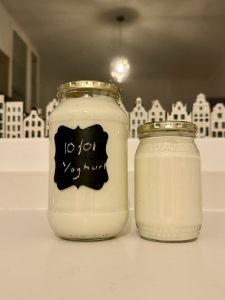
The yoghurt turned out surprisingly sweet; it retained its milky flavour, while acquiring a light tang. It’s a very pleasant taste and this will be the first time I don’t add honey when eating plain yoghurt. Unfortunately, some separation occurred and this variance in texture remained even after the yoghurt was strained. According to The Art of Fermentation2, yoghurt curdles when it is incubated at too high a temperature. During my next attempt, I won’t sterilise the jars right before incubation, and I will make sure that the oven is heated to its lowest setting (50ºC) and allowed to cool somewhat before using it as an incubator. However, when I scooped some yoghurt out the next morning, it had thickened and homogenised considerably. There was no separation and the tang had increased. Perhaps I just needed to chill it in the fridge for longer. All in all, I had a great time making this yoghurt and I’m so happy that it worked out despite the lack of lactose. University willing, I’ll keep making my own yoghurt for the foreseeable future.
References:
- Leavitt M [Internet]. How To Make Greek Yoghurt. The Mediterranean Dish; [updated 2025 May 25; cited 2026 Jan 10]. Available from: https://www.themediterraneandish.com/how-to-make-greek-yogurt/
- Katz SE. The Art of Fermentation: an in-depth exploration of essential concepts and processes from around the world. Vermont: Chelsea Green; 2012.
- Wallace J [Internet]. Yogurt Recipe. New England Cheesemaking Supply Co.; [n.d.; cited 2026 Jan 10]. Available from: https://cheesemaking.com/products/yogurt-recipe
- New England Cheesemaking Supply Co. [Internet]. Boost Your Gut Health with Homemade Yogurt. [n.d.; cited 2026 Jan 10]. Available from: https://cheesemaking.com/blogs/learn/boost-your-gut-health-with-homemade-yogurt